Structured evidence research and applied infrastructure design
Research at Northflow exists to design and validate structured evidence infrastructure for climate resilience, space-enabled systems, and mission-critical institutional environments. The program has produced published methodology, operational validation across multiple scientific domains, and deployed institutional systems.
The program is applied, systems-oriented, and governed by methodological discipline. Its purpose is not theoretical exploration, but the development of reproducible reasoning frameworks that support institutional decision-making under uncertainty.
The systems
Every system, one engine.
Each system is an adapter on the same reasoning and evidence layer. Status is not a marketing label: a system is listed operational only where a working implementation, an API, a repository, or a delivered report exists that a third party can open today.
Institutional research for climate, space, and critical systems
Northflow conducts applied research focused on structured evidence systems for climate resilience, space-enabled observation, Earth observation data fusion, and mission-critical institutional environments. Two core engines power the research program: HGE (hypothesis generation) and PSE (planetary sensing). Its outputs progress from methodological validation to deployable system architectures through structured institutional engagement.
Research focus
Research focus areas.
Northflow Research Lab conducts applied research across domains critical to climate resilience, space-enabled observation, and institutional system integrity.
Climate and infrastructure resilience
Evidence frameworks for resilience analysis across climate-exposed and mission-critical infrastructure domains. Integration of satellite observation data with structured hypothesis search for institutional decision support.
AI governance for mission-critical systems
Governance-aligned evaluation and evidence controls for bounded AI use in institutional and critical environments.
Research-to-infrastructure translation models
Structured pathways for moving governed research outputs into deployable institutional architectures. Methodology for converting validated research into operational systems with full provenance tracking and governance integration.
Institutional interoperability systems
Interoperability as evidence infrastructure: exchange, verification, and portability across institutions, sectors, and jurisdictions. Cross-border data and evidence sharing frameworks for European institutional environments.
Future research directions: Energy systems evidence infrastructure · Operational sovereignty frameworks, structurally aligned with HGE, activated after core institutional milestones.
Methodology
Project HGE: structured scientific discovery infrastructure.
Project HGE (Hypothesis Generation Engine) is Northflow’s core research methodology for structured hypothesis formation, evaluation, and evidence governance. HGE is not a product. It is a methodological program. It formalises:
Explicit hypothesis representation
Information-gain-driven experiment prioritisation
Deterministic execution and reproducible evaluation
Uncertainty tracking, drift detection, and provenance control
Current validation
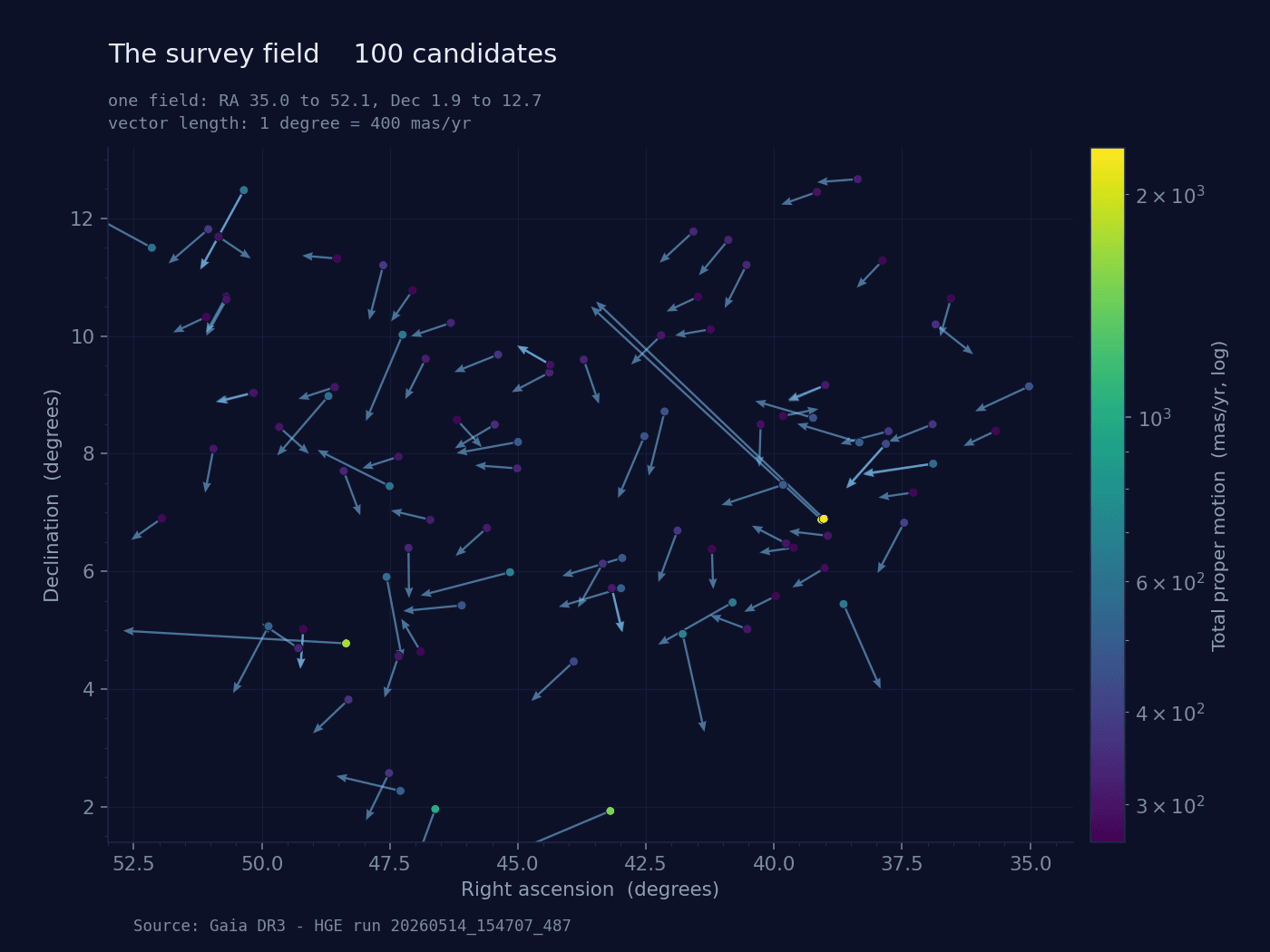
Operational on Gaia DR3 (1.8 billion sources, 220,656 candidates). In development for maritime intelligence (MARVIS: hindcast against two confirmed European subsea incidents). Live in humanitarian forecasting (CERES: 43 countries, public API and grading ledger). Confirmed on quantum physics (OQTOPUS: University of Osaka, 26 experiments).
Open source
PSE: open-source Earth observation data fusion.
PSE (Planetary Sensing Engine) is Northflow's open-source platform for spatiotemporal data fusion. It ingests data from multiple Earth observation sources, normalizes everything into a common spatiotemporal model, and serves the result through a single REST API. When sources overlap, PSE uses quality-weighted fusion, blending them based on reliability and recency rather than picking one.
PSE and HGE are sibling engines. PSE senses: it fuses observational data about the physical world. HGE thinks: it generates and evaluates hypotheses. Domain adapters connect to whichever engines they need. FLUX (renewable energy intelligence) is built on PSE. CERES (famine early warning) and MARVIS (maritime intelligence) are built on HGE.
Six live data connectors: ERA5, Open-Meteo, Global Solar Atlas, Sentinel-2, OpenStreetMap, World Bank
Quality-weighted multi-source fusion with conflict detection and provenance tracking
REST API built on FastAPI: point queries, bounding box queries, explicit fusion requests
Pangeo-native output: xarray Dataset, Zarr storage, Dask compatible
Open source under Apache 2.0: ~12,500 lines of Python, 200+ passing tests
First commercial adapter
FLUX: AI-powered renewable energy intelligence for developing countries. Solar PV and wind yield modeling, grid infrastructure analysis, financial modeling (LCOE/IRR/NPV), and climate risk assessment. Live for Indonesia, Kenya, and Vietnam. FLUX is proprietary. PSE is open source.
Domain adapter map
Interactive domain adaptation matrix.
Select a domain to review current status, source environment, and adaptation roadmap.
| Domain | Data Sources | Status |
|---|---|---|
| Space | Gaia DR3, astronomical catalogs | Operational |
| Famine Intelligence | CHIRPS v2.0, MODIS MOD13A3, UCDP GED (Uppsala), IPC, WFP VAM, FAO/WFP Cereal Price Index | Operational |
| Maritime Intelligence | Sentinel-1 SAR, BarentsWatch AIS, Havbase, DMA AIS, CMEMS TOPAZ4, ERA5 | In development |
| Quantum computing | University of Osaka, Center for Quantum Information and Quantum Biology; OQTOPUS (oqtopus.io) | Delivered |
| Earth Observation (PSE) | ERA5, Open-Meteo, Global Solar Atlas, Sentinel-2, OpenStreetMap, World Bank | Operational |
| Conflict Monitoring | Sentinel-1 SAR, Sentinel-2, VIIRS, UCDP (Uppsala), Copernicus EMS, Deepstate, OpenStreetMap | Operational |
| Climate / Earth Observation | ESA Sentinel, Copernicus EMS, ClimVal (CMIP6, ERA5, CORDEX) | In development |
| Longevity Biology | PubMed, Semantic Scholar, ClinicalTrials.gov, OpenTargets, OpenAI GPT-4o | In development |
| Biomedical | Structured clinical datasets, patient signal feeds | In development |
| Energy | Grid telemetry and resilience indicators | Research |
Space roadmap
Click any domain row to switch roadmap
- Operational baseline maintained through quarterly validation review.
- Extended uncertainty benchmarking scheduled.
- 220,656 candidate companions identified from 1.8 billion Gaia DR3 sources.
WHERE THIS IS GOING
Research directions
The pages above carry only what runs today. Ambition, wildfire and forest and marine monitoring, European energy, MARVIS v2, lives on a separate surface, labelled as direction rather than capability.
Archive
Publications and working papers.
Northflow maintains an archive of methodological notes, working papers, and applied framework documents. The research program is currently in early publication phase, with outputs focused on methodological validation and applied system architecture.
Showing 8 of 8 publications
CERES: Probabilistic famine early warning via structured hypothesis discovery
Preprint describing the CERES system for probabilistic 90-day famine risk forecasting across 43 countries. Establishes CERES as the first famine early warning system simultaneously providing probabilistic outputs, open-access machine-readable data, continuous weekly operation, and a public write-once prospective verification record. Published as open data on OCHA HDX under CC BY 4.0 from March to April 2026, then withdrawn while a listing better suited to the HDX relief collections is arranged. Current and historical forecasts are served through the CERES public API and the public ledger.
HGE applied to quantum processing: Technical evaluation report
26-experiment technical evaluation of HGE applied to the University of Osaka OQTOPUS quantum computing system across 3 phases. Depth invariance hypothesis confirmed at 90% confidence. Validates HGE instrument-agnostic architecture across astronomical and quantum physics domains.
Gaia DR3 validation summary: HGE structured hypothesis search at scale
Technical summary documenting operational validation of HGE on Gaia DR3 astronomical catalog data, including deterministic execution outcomes, reproducibility constraints, and evidence-bundle structure used for institutional review.
Research-to-infrastructure translation model
Methods note documenting the translation process from applied research outputs to deployable infrastructure components and operational frameworks.
AI governance for mission-critical systems
Brief addressing governance frameworks for AI deployment in mission-critical institutional systems, covering accountability, transparency, and operational control.
Interoperability as infrastructure
Framework brief examining interoperability as foundational infrastructure requirement for sovereign digital systems and cross-border coordination.
The European Flexibility Operating System (EFOS)
Initiative paper outlining EFOS as a proposed European public–private digital infrastructure for harmonised, cross-border energy system flexibility management, aligned with relevant European regulatory frameworks and energy system directives. Clarifies EFOS as a long-term digital backbone for EU system objectives, not a commercial software product.
Operational sovereignty in digital infrastructure
Research publication examining operational sovereignty principles and their application to institutional digital infrastructure design and governance.
Open science
Open tools and reproducible research.
Northflow contributes open-source tools and reproducible research notebooks to the scientific community. Institutional credibility requires transparency; our validation methodology, data pipelines, and research outputs are publicly available.
ClimVal: Climate Validation Library
Open-source Python library for structured statistical validation of climate model outputs. Provides Taylor diagrams, bias analysis, skill scores, and systematic model comparison workflows. Used as the quality validation layer for all Earth Observation data entering Northflow pipelines.
Northflow Notebooks: Reproducible Science
Reproducible science notebooks for climate, Earth observation, and space research. All notebooks run in-browser via Binder, no local setup required. Validation powered by ClimVal. Available notebooks: groundtruth: ERA5 station validation (Climate · March 2026) · CMIP6 Multi-Model Validation (Climate) · Arraylake + ClimVal Integration (Climate Data Infrastructure) · Sentinel-3 LST Validation (Earth Observation)
PSE: Planetary Sensing Engine
Open-source spatiotemporal data fusion for Earth observation. Six live data connectors (ERA5, Open-Meteo, Global Solar Atlas, Sentinel-2, OpenStreetMap, World Bank), quality-weighted fusion engine, and REST API. The data infrastructure layer for Northflow domain adapters.
CERES Public Repository
Full open implementation of the CERES famine early-warning system. Methodology, coefficient tables, validation data, and system architecture: everything described in the arXiv paper (arXiv:2603.09425).
Initiatives
Active research initiatives.
Current research initiatives addressing climate resilience, institutional evidence systems, and mission-critical infrastructure.
Initiatives represent active research, framework development, and early-stage publication work.
Infrastructure Resilience
Crisis-resilient digital infrastructure
Investigation of architectural patterns and operational protocols for maintaining digital continuity during crisis, disruption, or conflict scenarios.
AI & Governance
AI governance for mission-critical systems
Applied research into the safe, auditable, and bounded use of AI in institutional and mission-critical environments.
Research Methodology
Research-to-infrastructure translation models
Development of structured pathways for translating research outputs into deployable, governable, and trusted digital infrastructure.
Energy Systems & Infrastructure
European Flexibility Operating System (EFOS)
Research and framework development for a proposed European public–private digital infrastructure providing a harmonised, cross-border operational layer for predicting, coordinating, and managing flexibility across Europe’s energy system, aligned with relevant European regulatory frameworks and energy system directives.
Systems Architecture
Institutional interoperability systems
Research into interoperability as a permanent infrastructure layer across public systems, energy networks, and regulated sectors.
Digital Sovereignty
Operational sovereignty frameworks
Research into governance, architecture, and control mechanisms that enable states and institutions to retain operational authority over critical digital systems.
Approach
Research approach.
Research at Northflow is applied and systems-oriented. Outputs are governed by methodological discipline and designed to support institutional decision-making under uncertainty.
Problem definition
Define the institutional decision context, the uncertainty boundary, and the operational failure modes that matter.
Framework design
Specify reasoning and governance structures: what is claimed, what counts as evidence, and what can invalidate a conclusion.
Evidence mapping
Map data sources, standards, and prior work into an evidence basis that can be audited and reproduced.
Prototype and proof
Construct bounded prototypes to test whether the framework yields stable conclusions under realistic institutional constraints.
Institutional validation dialogue
Validate assumptions and evaluation criteria through structured dialogue with institutional stakeholders and operators.
Publication
Publish working documents as governed outputs: traceable versions refined through review, validation, and operational learning.
Collaboration
Research collaboration and dialogue.
Northflow engages in structured institutional dialogue and research collaboration within climate resilience, space-enabled observation, governance, and critical infrastructure domains.
Policy and standards dialogue
Engagement modeStructured dialogue on governance frameworks, regulatory alignment, and standards considerations for institutional evidence and critical infrastructure systems.
Engagement conditions
- Interest in digital infrastructure governance
- Understanding of European regulatory context
- Commitment to structured dialogue
Technical framework collaboration
Engagement modeCo-development of technical frameworks, architecture patterns, and evaluation approaches for institutional infrastructure and evidence systems.
Engagement conditions
- Technical expertise in relevant domains
- Focus on practical, deployable solutions
- Willingness to engage in structured knowledge exchange
Applied research exchange
Engagement modeStructured exchange of methodologies and findings addressing shared challenges in climate resilience, space observation, governance, and mission-critical institutional systems.
Engagement conditions
- Active research in relevant areas
- Commitment to applied research approach
- Interest in collaborative knowledge development
Pilot scoping and validation
Engagement modeScoping and validation of framework concepts in institutional contexts where applicable, with emphasis on bounded evaluation and evidence integrity.
Engagement conditions
- Institutional stakeholder with relevant interests
- Openness to exploratory pilot concepts
- Capacity for structured validation dialogue
Initiate dialogue
Institutions and organizations interested in research dialogue or collaboration opportunities should submit inquiries through the institutional engagement process.
Initiate institutional dialogue