
Laplace Discovery
Two questions, asked of every star in the Gaia catalogue.
Is this star alone, and does it make sense? The first question reads the pull of an unseen companion. The second predicts a star’s light from its motion and distance, then measures how far the prediction misses. Stars that fail either test are where Laplace looks.
Laplace is the astronomical adapter on HGE Core. The full field is open to anyone: you can fly through it, click a star, and read the same measured values the engine ranked it on.
1,811,709,771 Gaia DR3 sources · 220,656 candidates · 947 tier-1 cards
The survey
Every number carries its cut.
A candidate count means nothing without the selection that produced it. Each figure below is stated with the filter it came through, and the one figure that is a projection rather than a count says so.
Every object in the catalogue enters the selection.
Source: ESA Gaia DR3
RUWE at or above 1.4, parallax at or above 10 mas, parallax over error at or above 5, within 100 pc.
Source: HGE full-sky selection
Projected from an 8,680-source one percent sample in which 86.4 percent reached Tier-A. Not individually confirmed.
Source: HGE validation methods report
RUWE above 2, G brighter than 13, declination below plus 25.
Source: HGE full-sky catalogue build
Method
Two questions, two kinds of strange.
Laplace runs two independent tests over the same catalogue. One reads a physical pull. The other reads a modelling failure. A star can fail either, and the ones that fail both cleanly are the ones worth a telescope.
Channel one
Pull
Is this star alone?
A single star fits a single-star astrometric model. A companion drags it off that path, again and again, and the misfit shows up as RUWE. Near 1.0 the star is alone. Past 1.4 something unseen is tugging it, and in the working sets the value runs into the tens.
RUWE
1.0 alone · 1.4 selection threshold · 64.26 highest in the working sets
Channel two
Surprise
Does this star make sense?
Take how a star moves and how far away it sits, predict how bright it should be and what colour, then measure the miss. Most predictions land. A few miss badly: the light does not match the motion, and the engine is left surprised. The score is E, its significance is a robust z on the residual, and bootstrap resampling records how often the result survives.
E, z_main, persist_frac
z_main 8.74 to 34.83 across the 947 tier-1 cards · persist_frac 1.0 on all 947
What the two channels measure against each other.
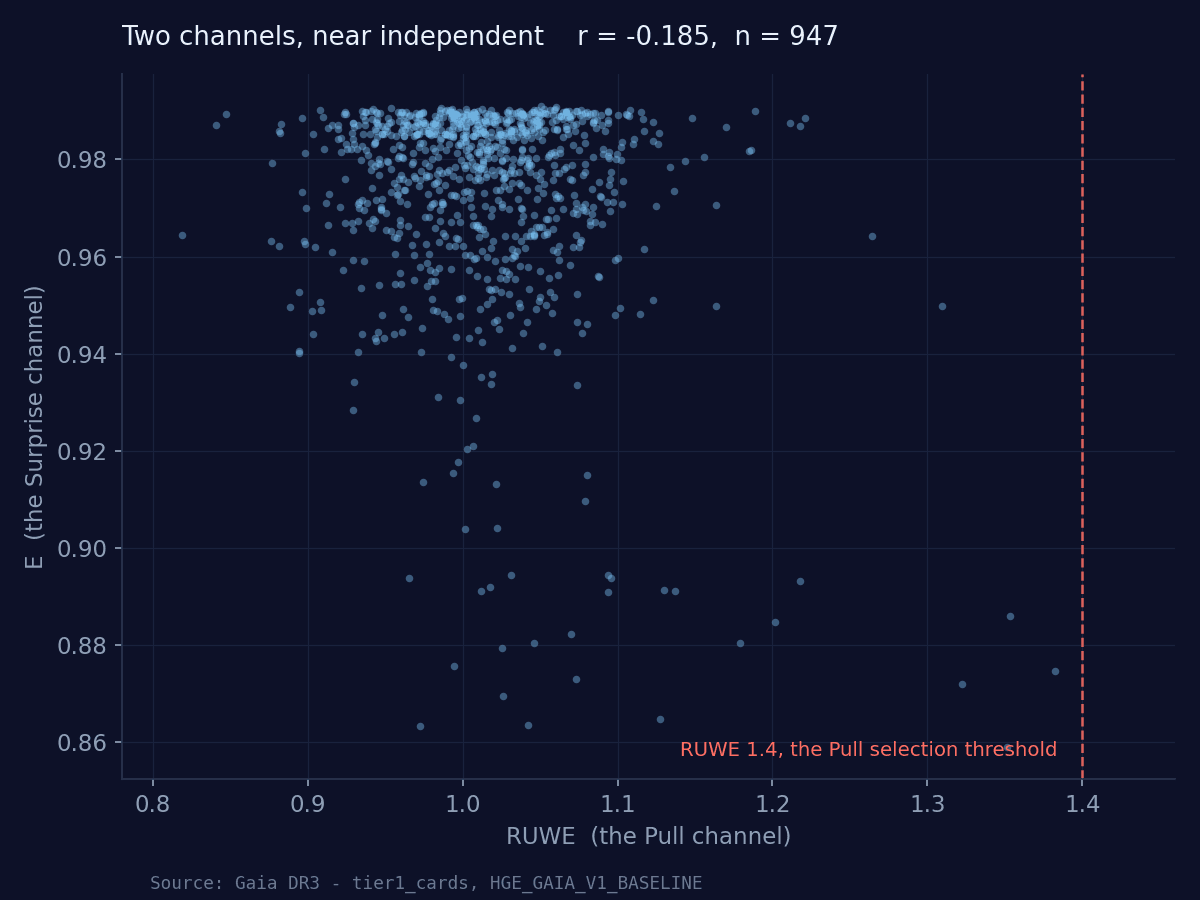
Correlation
−0.185
Pearson correlation between E and RUWE over the 947 tier-1 cards. The channels are close to independent, and they arrive there by measurement rather than by construction.
Pilot field RUWE ceiling
1.382
The highest RUWE anywhere in the pilot field sits below the 1.4 threshold. Every candidate it produced is a Surprise, and the interface describes them that way.
Source: tier1_cards, HGE_GAIA_V1_BASELINE, n = 947
The sky is not finished. It was only unread.
Rendered from Gaia DR3 run cards · positions from ra and dec, size from G magnitude, colour from bp_rp
The field
A real patch of sky, rendered whole.
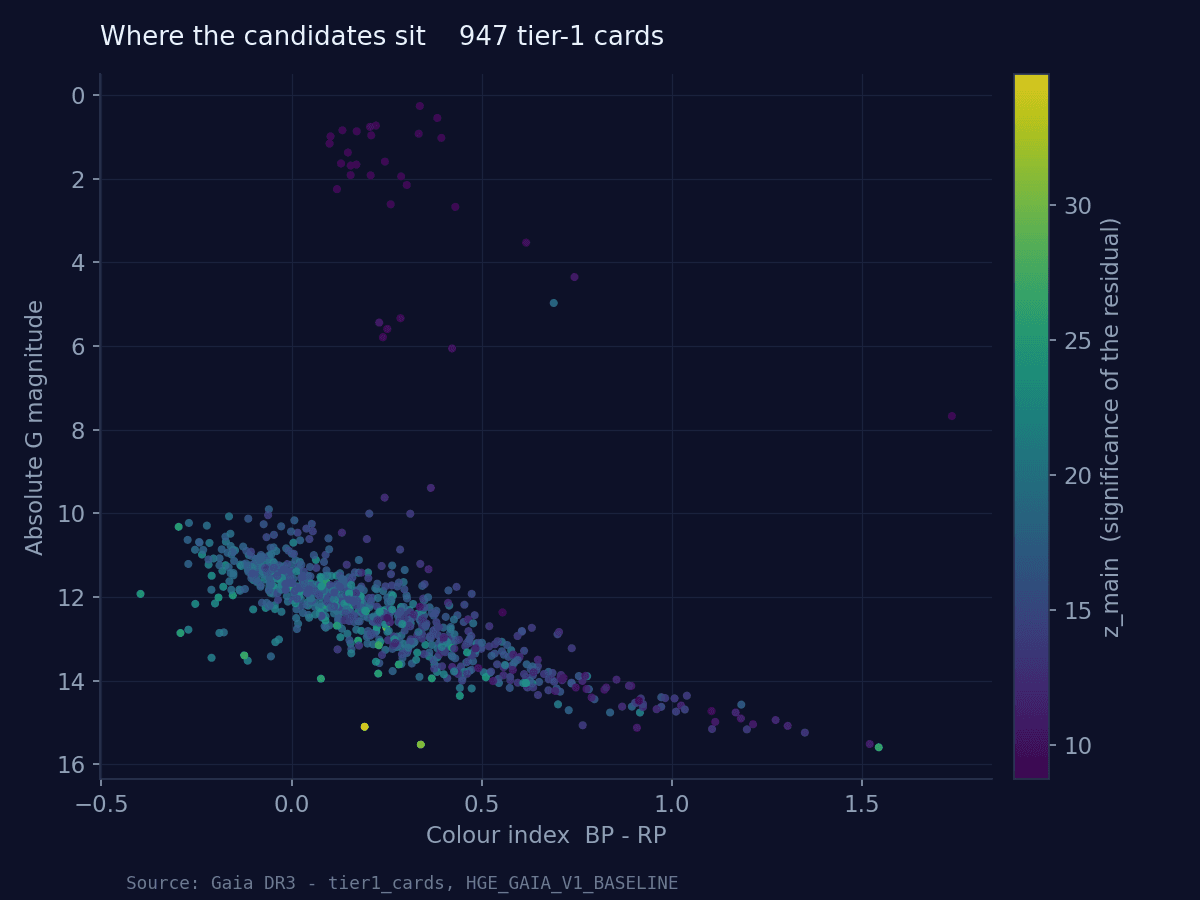
The public experience renders one contiguous Gaia DR3 field in full, with no imputation and no synthetic stars. Positions come from parallax, colour from the measured bp_rp index, brightness from G magnitude. What you orbit is the catalogue.
- Field
- HGE_GAIA_V1_BASELINE
- Sky patch
- RA 22.5 to 78.7, Dec 0.0 to 41.8 (Taurus, Perseus, Aries)
- Stars rendered
- 600,000, every one with positive parallax and full photometry
- Tier-1 candidates
- 947, all inside the rendered field
- Candidate distances
- 29.1 to 4,519.6 pc
- Candidate G magnitude
- 6.33 to 20.26
Why no star here has a famous name
The widely cited full-sky candidates, LSPM J0248+1000, HD 237266, G 234-56 and G 154-43, are not members of this field. Each rendered star is identified by its Gaia DR3 source id and carries its measured values only.
Candidates
One run, individual discoveries.
Finder charts for high-proper-motion candidates surfaced in a single Gaia DR3 run. Each marks the target, its neighbours, and the measured proper-motion vector, reproducible from the recorded run.
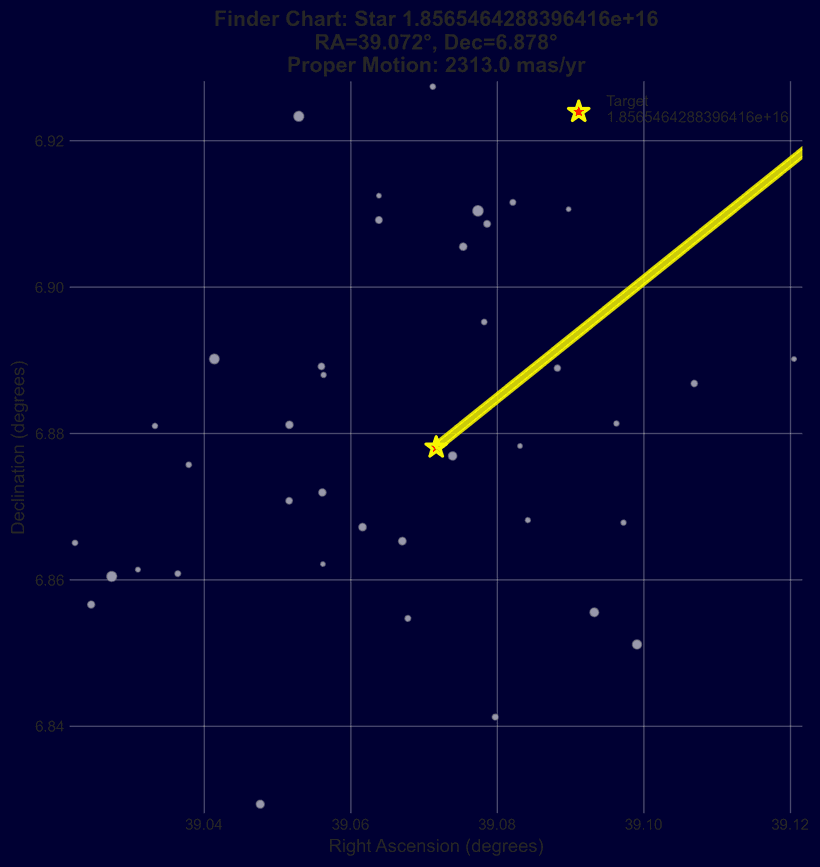
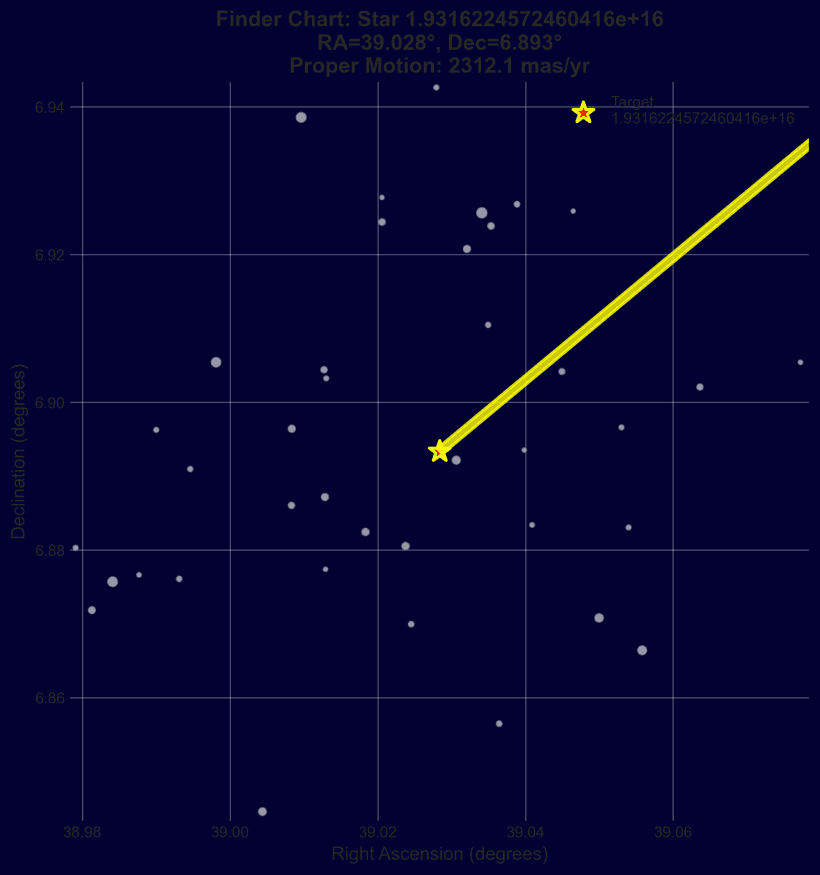
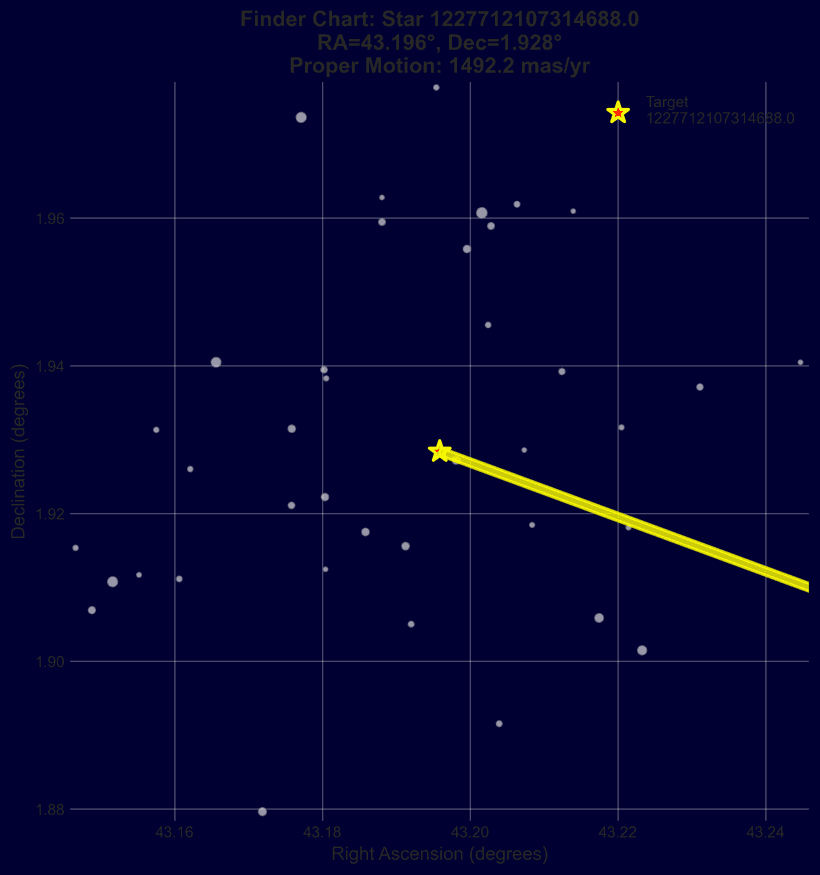
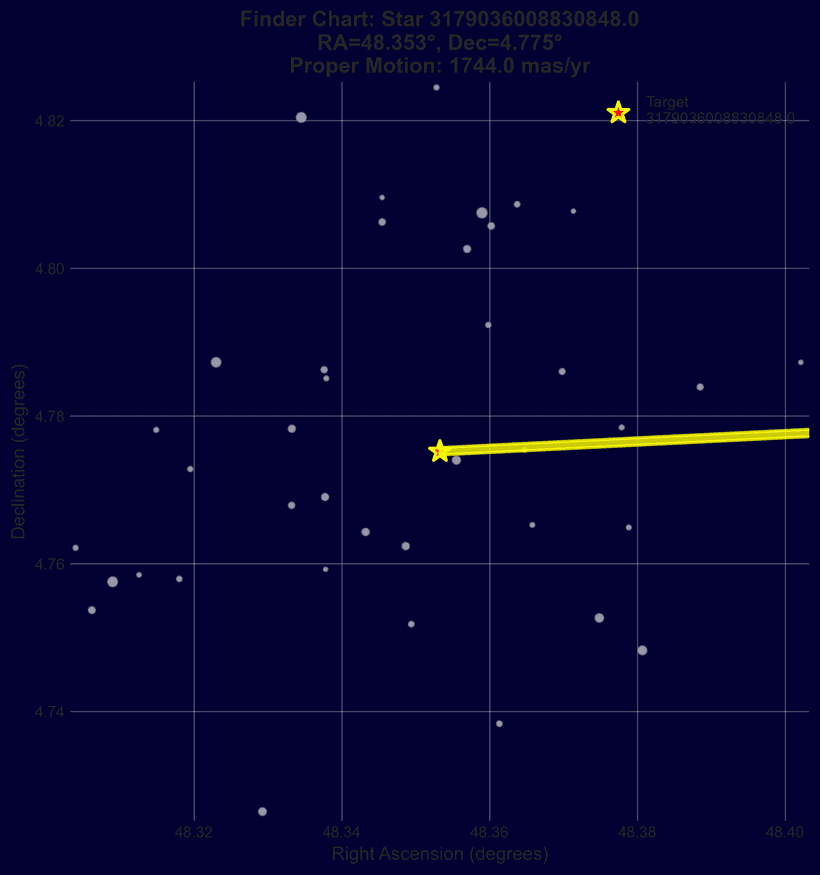
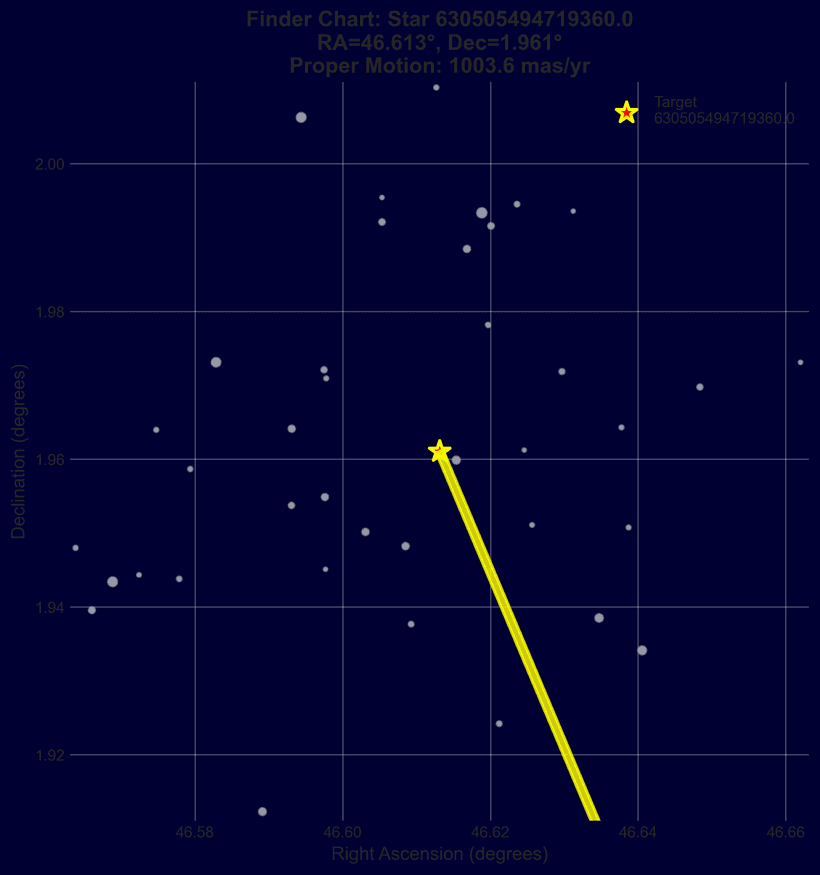
SOURCE · Gaia DR3 run · finder charts, proper-motion vectors in yellow
Open it
Three ways in.
The open field
Fly through the rendered Gaia DR3 field, click any star, and read the measured values it was ranked on. No account, no request.
sky.northflow.no →The working platform
Sky survey, observation planner, NSS solutions browser, spectroscopy queue and publications tracker. Access controlled.
laplace.northflow.no →The engine underneath
Laplace is an adapter. HGE Core holds the hypothesis states, the scoring and the ledger that every adapter writes to.
/research/hge →