
European scientific infrastructure · in production
Scientific discovery infrastructure for Earth, space, and critical systems.
Europe built the instruments. Northflow builds the reasoning, the evidence and the accountability above them.
Rendered from Laplace results · 220,656 candidates · 1.8B Gaia DR3 sources
Observation is no longer the constraint. Interpretation is.
Sensors, models and constellations return more of the physical world in a day than the scientific community can reason through in a year. Northflow builds the machines that read it: systems that form a hypothesis, run it against real instruments, and produce evidence that survives review.
Five systems in operation.
Status reflects external verifiability, not internal progress. A system is listed operational only where a working implementation or a documented validation exists.
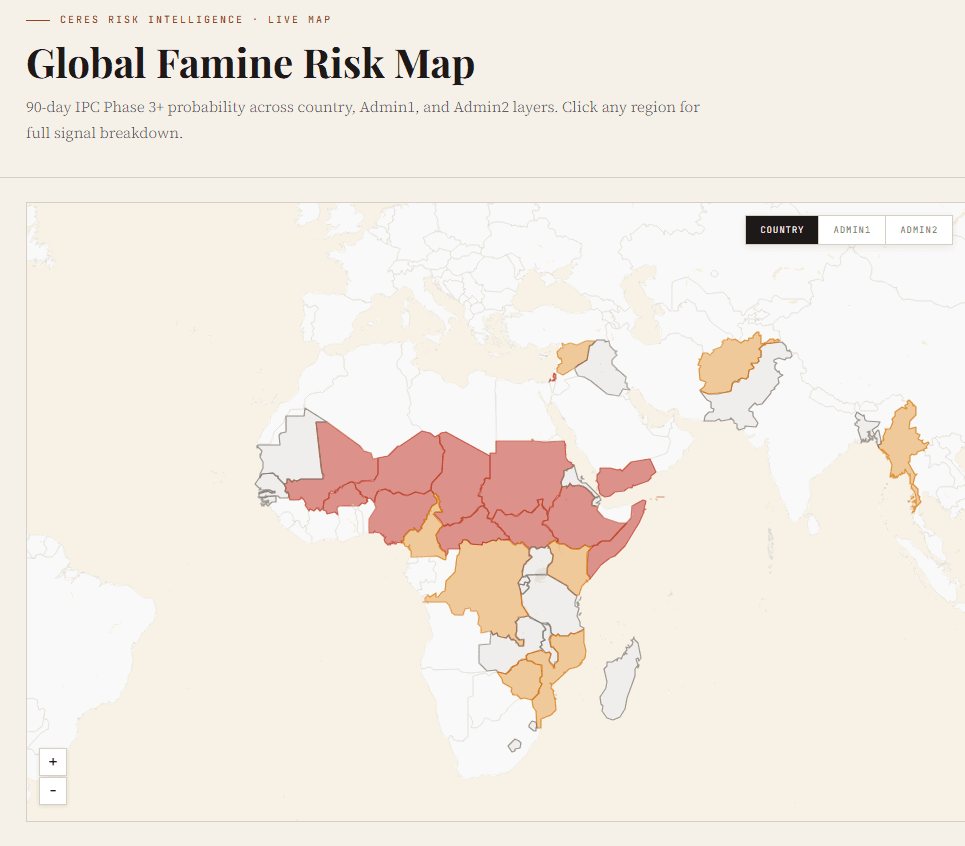 CERES · global famine risk · weekly 90-day forecast
43-country probabilistic famine risk, registered before the outcome and graded against IPC at T+90 in a public record. Overview →
9,868 infrastructure assets across five conflict zones in Ukraine. EU-hosted, GDPR-native, offered at no cost. Overview →
Six live connectors normalised into one spatiotemporal model, fused by quality, full provenance. Open source, Apache 2.0. Overview →
Solar and wind yield, grid connection and climate risk for renewable development. Live in Indonesia, Kenya, Vietnam.
220,656 candidate companions from 1.8 billion Gaia DR3 sources, deterministic replay verified across the full run.
Live from the CERES grading ledger
Graded against outcomes, in public.
Every CERES forecast is registered before the outcome is known and graded at T+90 days against IPC outcomes. The figures below are read directly from the public grading ledger, and precision and recall are reported together.
We can see more of the Earth than we can understand.
Contains modified Copernicus Sentinel-2 data, North Sea, processed by Northflow
One architecture, tested where it counts.
Two engines, many adapters. The same reasoning and evidence layer, proven across environments that share no format, cadence, or failure mode. A new field costs an adapter rather than a platform.
| Domain | Instrument environment | What it showed |
|---|---|---|
| Astronomy | Gaia DR3, 1.8 billion objects | Structured hypothesis search at scale, deterministic replay verified |
| Quantum physics | University of Osaka OQTOPUS system | 26 experiments, depth invariance at 90% confidence, delivered February 2026 |
| Humanitarian | UCDP GED, CHIRPS, MODIS, IPC | Operation under deep uncertainty, prospective public grading |
| Maritime | Sentinel-1 SAR, AIS | Bayesian inference over sparse, noisy observation |
Evidence that survives being checked.
Automated analysis is about to sit under Europe's largest decisions. Northflow builds the evidence layer beneath it: results that can be reproduced, signed, and independently verified.
Identical inputs produce identical outputs. Any result can be replayed independently.
Every evidence artifact carries an Ed25519 signature and a SHA-256 integrity hash.
Where the domain allows, forecasts are registered before the outcome and graded against it, in public.
The data pipelines and validation tooling are open source and runnable, from PSE to the notebooks.
Open record
Read it at the source.
The forecasts, the method and the validation are published where they can be inspected directly. Each link opens the source itself.
Questions
The short answers.
- What is Northflow Technologies?
- Northflow Technologies is a Norwegian deep-tech company that builds institutional-grade evidence infrastructure: systems that turn uncertain observational data into reproducible, signed, independently verifiable intelligence. One reasoning engine, HGE, runs across Earth observation, space, humanitarian forecasting, maritime and conflict monitoring.
- What is HGE, the Hypothesis Generation Engine?
- HGE is Northflow’s core reasoning and evidence layer. It forms explicit, testable hypotheses, runs them against real instruments, and produces signed evidence bundles that can be replayed deterministically. Each application domain is an adapter on the same engine.
- Is Northflow’s intelligence real and independently verifiable?
- Yes, and the two halves of that are worth separating. Results are deterministic and carry an Ed25519 signature and a SHA-256 integrity hash, which can be checked today. Where the domain allows, forecasts are also committed to a public append-only ledger before the outcome is known, and graded against it when the outcome publishes. None of the CERES forecasts are graded yet: the first 90-day horizons closed in April 2026 and IPC publishes observed classifications two to four months behind, so grading begins in the autumn.
- What is CERES?
- CERES is Northflow’s probabilistic famine early-warning system. It produces weekly 90-day IPC Phase 3+/4+/5 risk forecasts across 43 countries. Every forecast is written to a public write-once ledger before the outcome is known and can never be revised, which is the part a sceptic can verify now. Grading against observed IPC outcomes at T+90 begins when those outcomes publish. The methodology is a preprint, arXiv:2603.09425.
- Has Northflow ever withdrawn results?
- Once, and it is on the record. Four CERES runs from March 2026 were withdrawn from the score because two satellite adapters fell back to synthetic data when their live sources failed and expert priors were still in place. That is 172 forecasts, and it was 19 percent of everything issued at the time. They keep their original probabilities, are excluded from every published metric, and can never be scored, for us or against us. The reason sits next to them in the ledger at ceres.northflow.no/validation.
- What do the status labels mean?
- They are load-bearing, not marketing. “Operational” means a working implementation, an API, a repository, or a delivered report a third party can open today. “In development” is not yet operational. “Delivered” is a completed evaluation rather than a running capability.
- How do I work with Northflow?
- Northflow works with space and defence agencies, government entities, research institutions and infrastructure operators. Enquiries reach a named engineer, not a queue. Start at the engagement page.
Engagement
Talk to us.
Northflow works with space and defence agencies, government entities, research institutions and infrastructure operators. Enquiries reach a named engineer, not a queue.