Hypothesis Generation Engine
Structured scientific discovery infrastructure
HGE converts complex observational data into verifiable evidence through machine-driven hypothesis search, deterministic execution, and audit-grade provenance tracking. Validated on Gaia DR3 astronomical catalog. Deployed in production across humanitarian forecasting (CERES) and quantum physics (OQTOPUS), with maritime intelligence (MARVIS) in development. ESA Sentinel Earth Observation adaptation in progress.
Built for institutional environments where reproducibility, auditability, and long-term operational integrity are non-negotiable.
Deterministic execution · Signed evidence bundles · Gaia DR3 validated · MARVIS · CERES · OQTOPUS
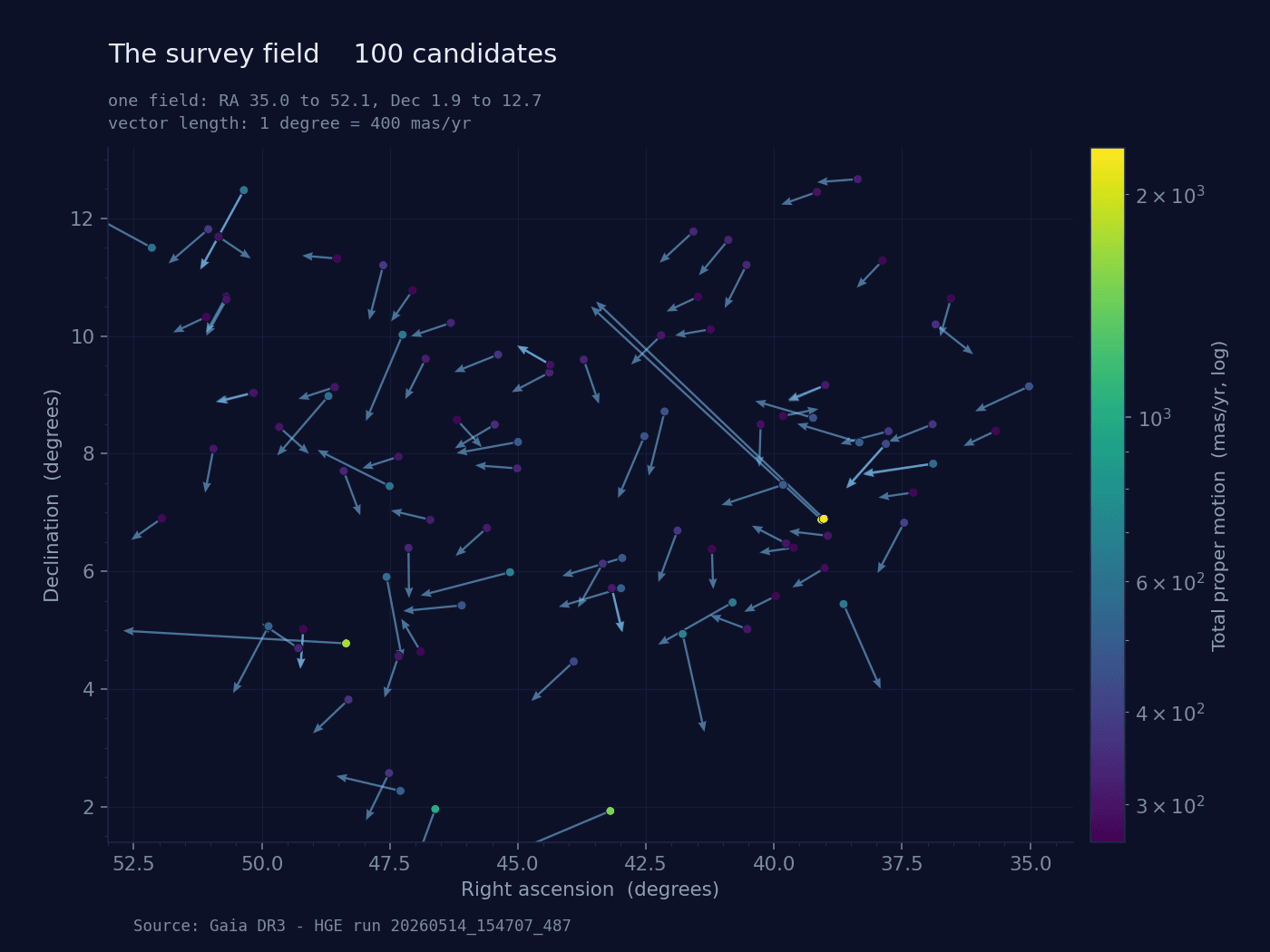 Gaia DR3 · one survey field · from an HGE run
The engine
Infrastructure for structured discovery.
HGE is not a product. It is a methodological program for automated scientific discovery: a domain-agnostic system that formalizes hypothesis generation, evaluation, and verification under uncertainty. It enables institutions to conduct systematic, resource-efficient exploration of complex problem spaces where traditional approaches are limited by cost, time, or physical constraints.
The engine is instrument-agnostic by design. It has been operationally validated across astronomical observation (Gaia DR3), humanitarian forecasting (CERES: 43 countries, live), and quantum physics (OQTOPUS, University of Osaka), and hindcast for maritime intelligence (MARVIS, in development, against two confirmed European subsea incidents). Every execution produces signed evidence bundles: tamper-resistant, auditable artifacts designed for institutional review, regulatory scrutiny, and cross-border verification.
Explicit hypothesis representation
Structured, machine-readable hypotheses enabling formal evaluation and cross-domain application
Information-gain prioritization
Experiments ranked by expected epistemic value, respecting resource constraints and operational limits
Deterministic execution
Identical inputs produce identical outputs. Full replay capability ensures independent verification
Uncertainty-aware provenance
Complete audit trail from raw data to conclusion, with confidence tracking and drift detection

A billion sources. The engine keeps the ones that do not belong.
Rendered from a Gaia DR3 run · high-proper-motion candidates
Methodology
Four-stage discovery cycle.
HGE implements a closed-loop methodology that mirrors the scientific method while operating autonomously under real-world constraints. Each cycle increases confidence in validated hypotheses while identifying new areas of uncertainty.
Hypothesis generation
System formulates testable hypotheses based on current knowledge state, uncertainty estimates, and domain constraints. Hypotheses are structured to enable falsification and quantitative evaluation.
Experiment design
Experiments are designed to maximize expected information gain while respecting instrument capabilities, resource constraints, and operational limits. Design prioritizes hypotheses with highest epistemic value.
Deterministic execution
Experiments are executed with full provenance tracking. Deterministic execution ensures identical conditions produce identical results, enabling independent verification and audit-grade evidence generation.
Belief update and iteration
Observed results update confidence through structured reasoning. Updated beliefs inform the next cycle of hypothesis generation, creating a continuous discovery loop with full traceability.
Methodological principle: Each cycle increases confidence in validated hypotheses while identifying new areas of uncertainty, enabling systematic exploration of complex problem spaces under resource constraints.
Pipeline
Data to evidence pipeline.
Interactive execution flow: Data → Hypotheses → Experiments → Evidence. Select each stage to review technical specifications and live adapter readiness.
Data stage specifications
Observational datasets are normalized, quality-checked, and mapped into reproducible evidence contexts.
- Schema harmonization across instrument sources
- Outlier and drift pre-check pipeline
- Provenance event creation at ingestion
Live adapter status
Same engine, every adapter
Gaia DR3: Astronomy
OperationalCERES: Famine forecasting
OperationalPSE: Earth observation fusion
OperationalFLUX: Renewable energy
OperationalORION: Conflict monitoring
OperationalOQTOPUS: Quantum computing
DeliveredMARVIS: Maritime intelligence
In developmentSentinel: Earth observation
In developmentAION: Longevity biology
In developmentATHENA: Women's health
In developmentProof
Operational validation.
HGE capabilities are backed by working implementations and documented validation artifacts.
Gaia DR3 astronomical validation
OperationalHGE operationally validated against the Gaia Data Release 3 catalog, one of the largest structured scientific datasets available (1.8 billion objects). Demonstrates structured hypothesis search at scale, with deterministic execution and reproducible evidence outputs across billions of observational records.
Metrics
- 1.8 billion catalog objects
- Deterministic replay verified
- Full provenance tracking operational
- Validation artifact: Available
Evidence verification system
Operational5-step verification contract producing signed evidence bundles with deterministic replay, audit invariants, policy gating, and tamper resistance. Tested against 6 adversarial attack vectors through dedicated red-team tamper suite.
Capabilities
- Cryptographic signing
- Deterministic replay
- Audit invariants enforced
- Red-team validated
CERES: Humanitarian famine forecasting
OperationalHGE deployed in production for 43-country probabilistic famine risk forecasting. Weekly 90-day IPC Phase 3+/4+/5 forecasts. Published methodology (preprint): arXiv:2603.09425. Prospective performance tracked in a public write-once grading ledger.
Metrics
- 43 countries: ~95% of active IPC Phase 3+ caseload
- Public prospective grading ledger: CERES API /v1/grades
- Published as open data on OCHA HDX under CC BY 4.0 from March to April 2026, then withdrawn while a better-suited HDX listing is arranged; served through the CERES public API
- Live at ceres.northflow.no
MARVIS: Maritime infrastructure threat detection
In development5-layer Bayesian inference pipeline (v2, in development) for European subsea infrastructure threat detection. 7 hypothesis classes including 3 novel detection methods. Hindcast against two confirmed European subsea infrastructure incidents; no prospective or live detection claimed. NIS2-aligned alert infrastructure design.
Metrics
- 7 hypothesis classes, 5 regions
- Hindcast: Nord Stream, Eagle S/Estlink-2
- In development at marvis.northflow.no
Sentinel Earth Observation adaptation
In developmentActive adaptation of HGE for ESA Sentinel satellite data. Targeting wildfire risk modelling, deforestation verification, and infrastructure vulnerability mapping.
Focus areas
- Wildfire risk hypothesis generation
- Deforestation pattern detection
- Infrastructure stress indicators
OQTOPUS: Quantum computing evaluation
Delivered26 autonomous experiments across 3 phases on the University of Osaka OQTOPUS quantum computing system. Depth invariance hypothesis confirmed at 90% confidence. Technical evaluation report delivered to University of Osaka (Dr. Naoyuki Masumoto). Validates HGE instrument-agnostic architecture across astronomical and quantum physics domains.
Validation metrics
- 26 experiments across 3 phases
- Depth invariance confirmed at 90% confidence
- Technical report delivered: Feb 2026
- Instrument-agnostic architecture validated
Gaia DR3 run
Real output from a Gaia DR3 run.
These are figures from an actual HGE run over Gaia Data Release 3, not illustrations. The run selects on total proper motion across a single survey field and places every candidate on the colour-magnitude diagram, reproducible from the recorded run.
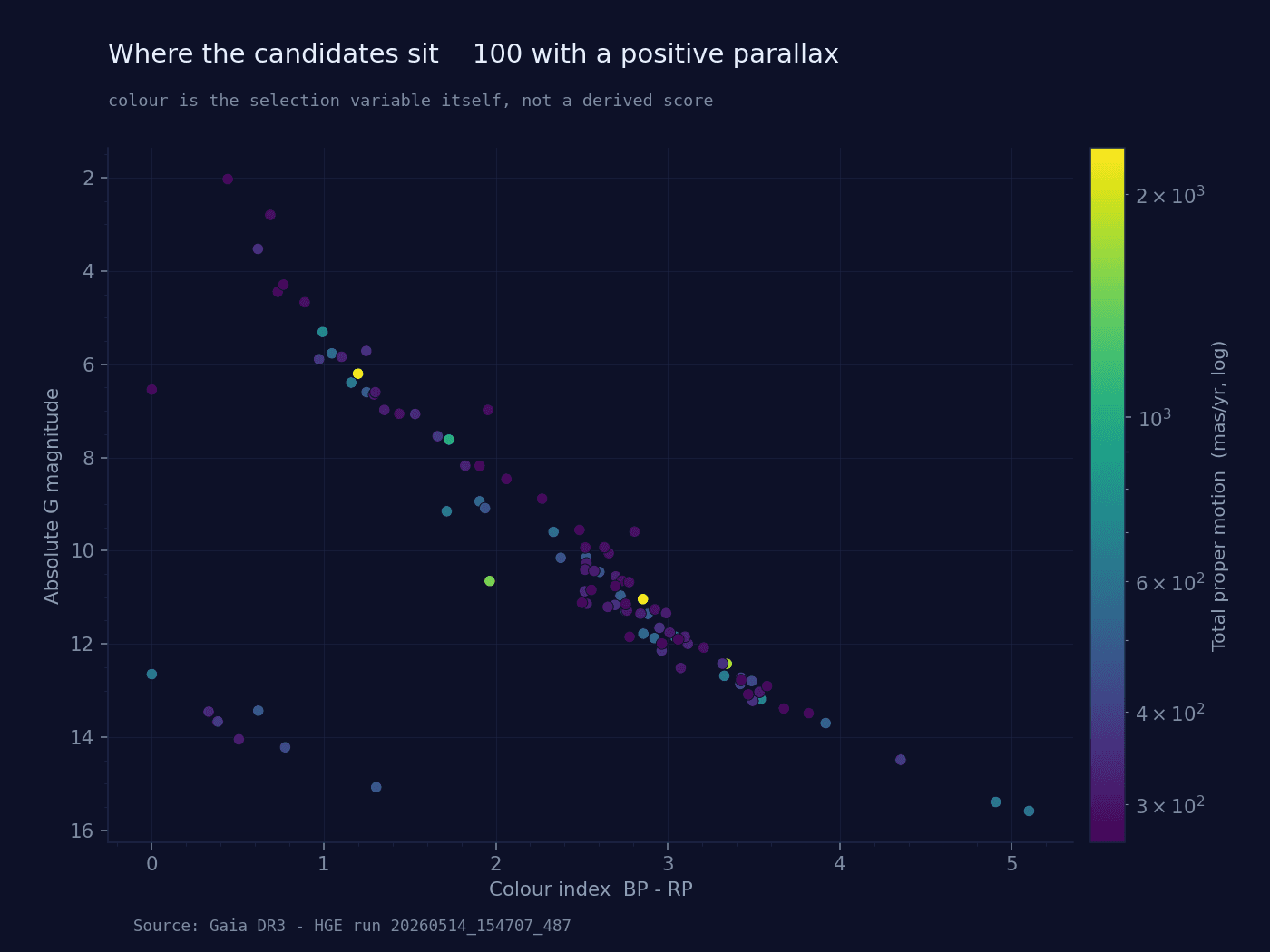
SOURCE · HGE Gaia DR3 run · deterministic, provenance-recorded
Candidates
One run, individual discoveries.
Finder charts for high-proper-motion candidates surfaced in a single Gaia DR3 run. Each marks the target, its neighbours, and the measured proper-motion vector, reproducible from the recorded run.
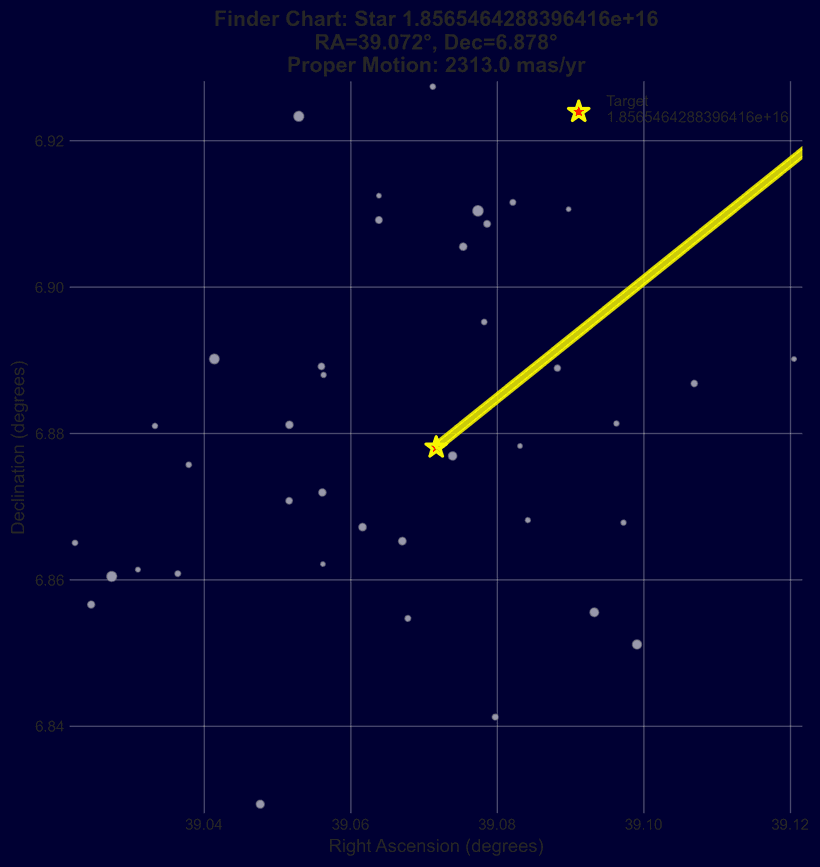
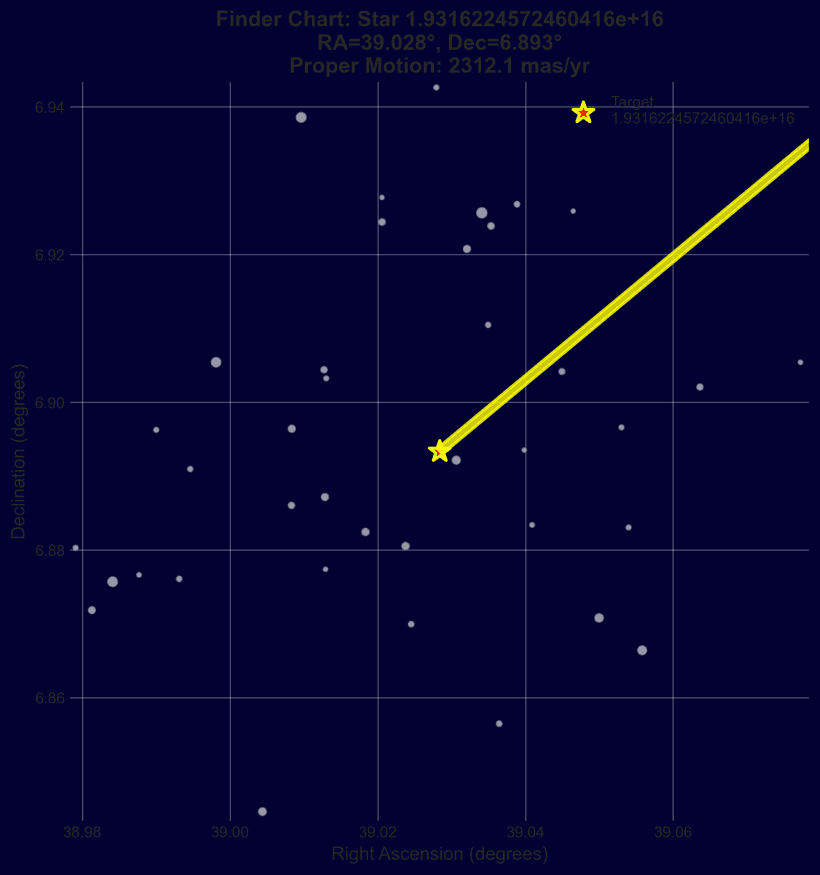
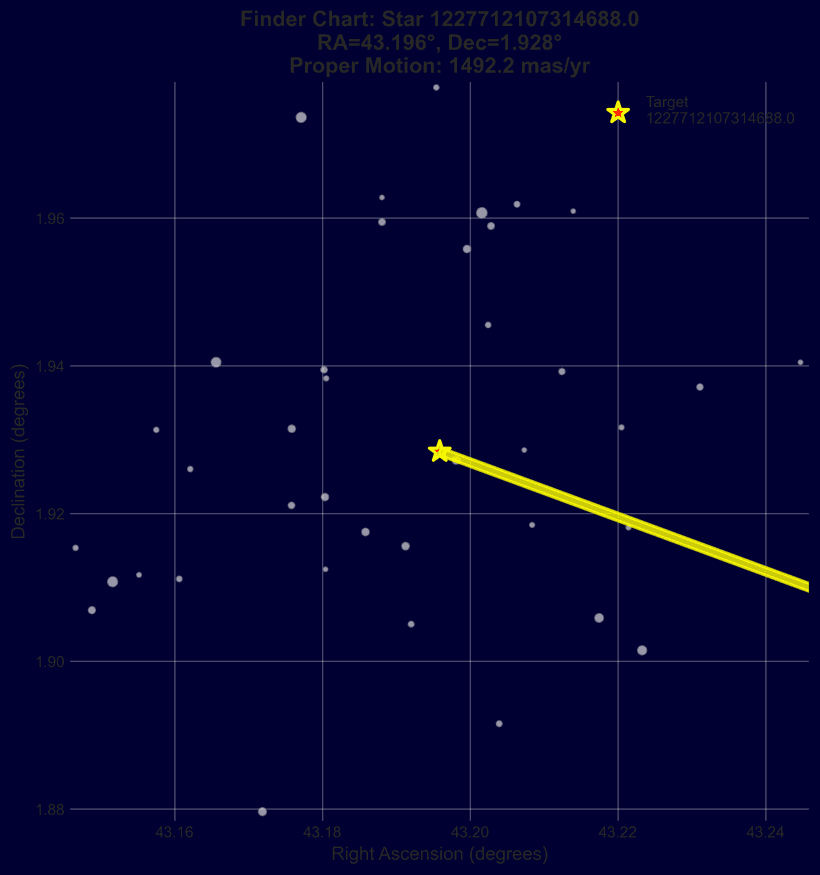
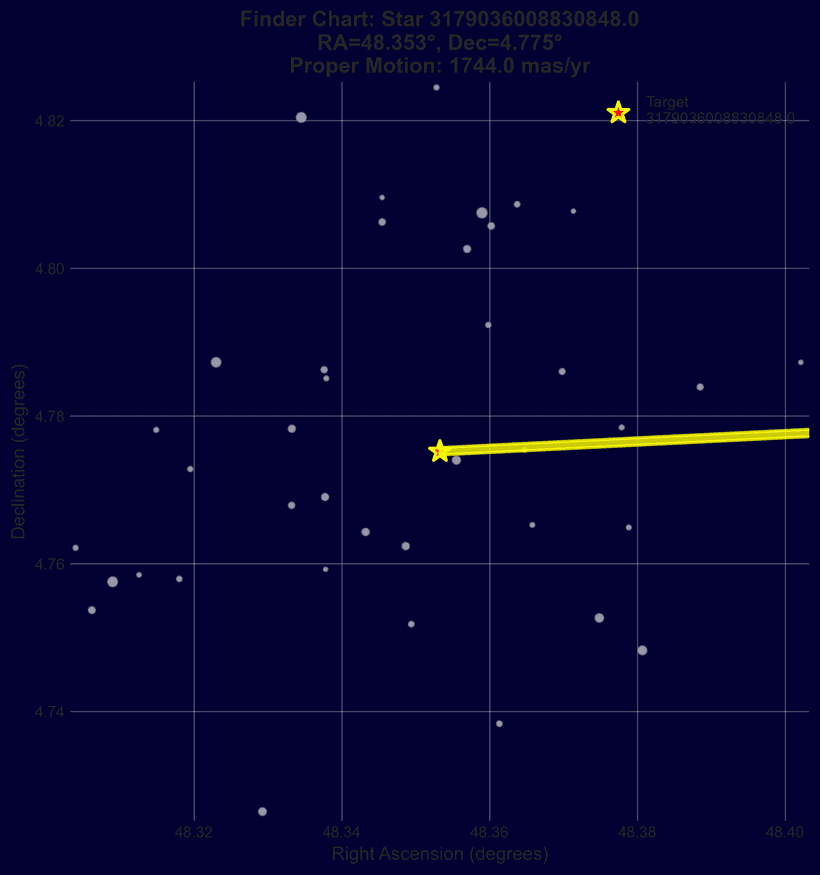
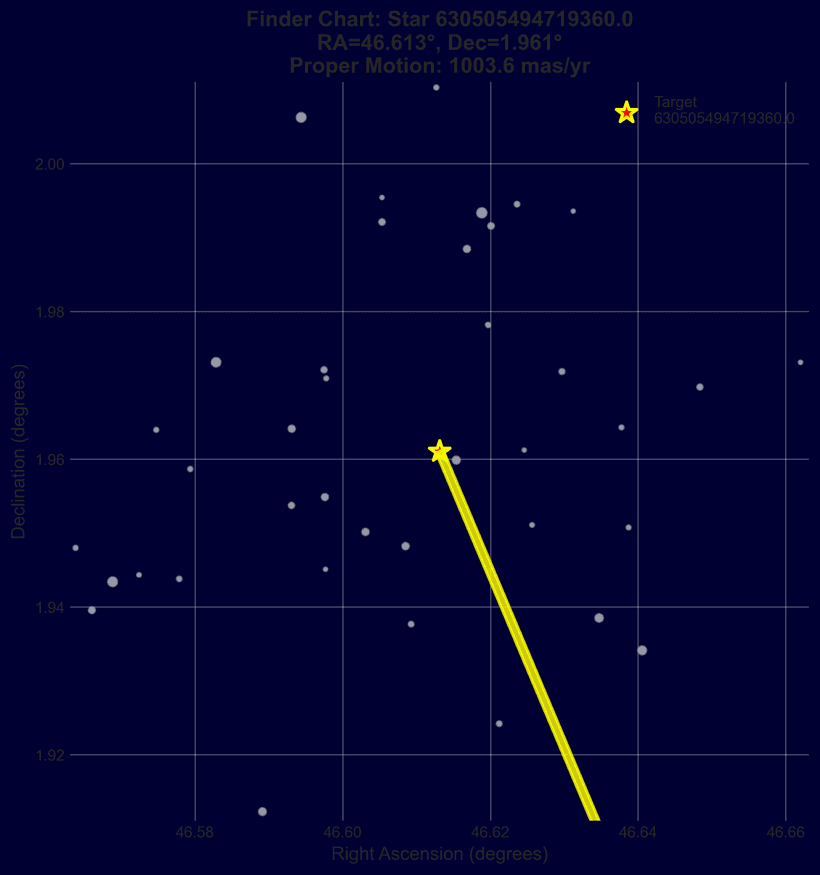
SOURCE · Gaia DR3 run · finder charts, proper-motion vectors in yellow
Domain adapters
One engine. Multiple application domains.
HGE is domain-agnostic by architecture. Each application domain is a structured adapter connecting the engine to specific observational environments and institutional contexts.
| Domain | Data Sources | Status |
|---|---|---|
| Space & Astronomical Observation | Gaia DR3: 1.8B sources, 220,656 candidates | Operational |
| Humanitarian Forecasting | CHIRPS, MODIS, UCDP GED (Uppsala), IPC, WFP VAM, FAO/WFP | Operational |
| Conflict Monitoring | Sentinel-1/2, VIIRS, UCDP (Uppsala), Copernicus EMS, Deepstate, OpenStreetMap | Operational |
| Earth Observation (PSE) | ERA5, Open-Meteo, Global Solar Atlas, Sentinel-2, OpenStreetMap, World Bank | Operational |
| Renewable Energy (FLUX) | PSE data fusion, pvlib, OpenStreetMap grid infrastructure | Operational |
| Quantum Physics | University of Osaka OQTOPUS system | Delivered |
| Maritime Intelligence | Sentinel-1 SAR, BarentsWatch AIS, CMEMS, ERA5 | In development |
| Earth Observation & Climate | ESA Sentinel, Copernicus | In development |
| Longevity Biology | PubMed, Semantic Scholar, ClinicalTrials.gov, OpenTargets, GPT-4o | In development |
| Women's Health | Clinical datasets, patient signal feeds | In development |
Current domains reflect active development and institutional engagement. Future domains are structurally enabled by HGE's architecture and will be activated after core validation milestones are achieved.
Specifications
Technical foundation.
Core capabilities
- Structured hypothesis representation (JSON-LD schemas)
- Bayesian experiment prioritization
- Deterministic execution engine
- Cryptographic evidence signing (Ed25519)
- Provenance tracking (W3C PROV-aligned)
- Drift detection and confidence updating
- Governance modes: disabled / logging / enforced
Integration
- Instrument-agnostic backend interface
- REST API for experiment orchestration
- Webhook callbacks for asynchronous instruments
- Containerized deployment
- PostgreSQL/MongoDB persistence options
- GDPR-aligned data handling
Engagement
Research access & technical briefings.
HGE technical materials, validation artifacts, and system documentation are maintained internally and shared selectively with qualified research partners, funding agencies, and institutional collaborators. Public releases follow partner validation and governance review.
Public institutional materials
Framework overviews, validation summaries, and general system descriptions available through this website.
Structured engagement
Technical specifications, implementation guides, and operational procedures provided through institutional dialogue.
Controlled disclosure
Detailed architectural documentation, security specifications, and validation datasets subject to qualification requirements and confidentiality protocols.
Discuss research collaboration.
Institutions and research organizations interested in exploring HGE methodology, validation approaches, or potential collaborative applications are invited to initiate structured dialogue through the institutional engagement process.
Engagement follows structured institutional dialogue protocols. Response times vary based on inquiry complexity and alignment with current research priorities.