CERES
Calibrated Early-warning & Risk Estimation System
CERES is a probabilistic famine early warning system producing weekly 90-day IPC Phase 3+/4+/5 risk forecasts across 43 countries. Every prediction is publicly verifiable through a write-once prospective grading ledger, the first of its kind in famine intelligence.
CERES forecasts were published as open data on the OCHA Humanitarian Data Exchange under CC BY 4.0 from March to April 2026. Current and historical forecasts remain continuously available through the CERES public API and the public grading ledger. Published methodology: arXiv:2603.09425 (preprint).
43 countries · Weekly forecasts · 87 IPC transitions · Public grading ledger · CC BY 4.0
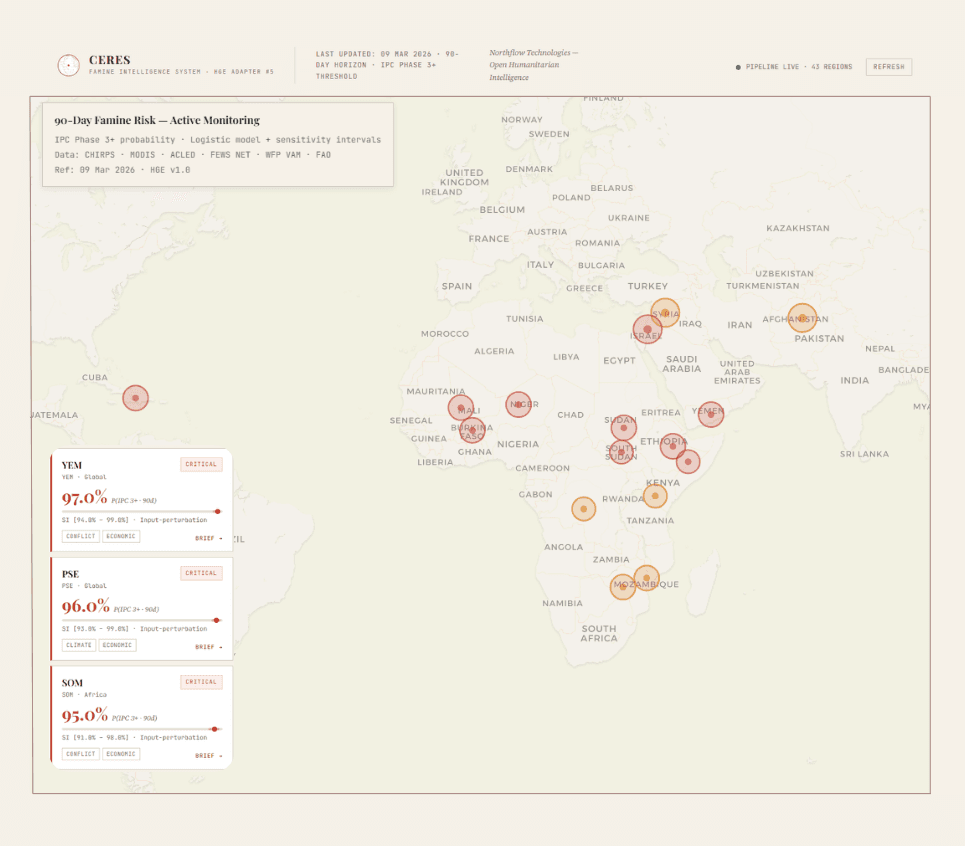 CERES dashboard · global famine risk · March 2026
43
Countries covered
~95%
of active IPC Phase 3+ caseload
87
IPC transition records
Weekly
Forecast cadence
Why CERES
What makes CERES different.
Existing famine early warning systems (FEWS NET, IPC, WFP HungerMap, INFORM) do not publish prediction-level accuracy records. CERES does.
Probabilistic outputs
CERES produces P(IPC 3+), P(IPC 4+), and P(IPC 5) probability distributions, not ordinal ratings. Every forecast includes 90% sensitivity intervals from 2,000 input-perturbation draws.
Public verification ledger
Every prediction carries a unique ID (CERES-HYP-{ISO3}-{YYYYMMDD}-{hex}). At T+90 days each is graded against IPC outcome data. The grading record is public via the /v1/grades endpoint and tamper-evidenced by Git commit history.
Open data, open API
CERES forecasts were published as open data on the OCHA Humanitarian Data Exchange under CC BY 4.0 from March to April 2026. A rate-limited public REST API provides continuous machine-readable access to all forecasts, hypotheses, and graded outcomes, including the public grading ledger.
Multi-source convergence
6 independent data sources: precipitation anomaly (CHIRPS), vegetation stress (MODIS), conflict events (UCDP GED), IPC classification, food consumption scores (WFP VAM), and cereal price index (FAO/WFP). UCDP GED is an academic, openly licensed, university-hosted conflict dataset. Convergence scoring detects cross-signal alignment.
Methodology
From six signals to a graded forecast.
Runs every Monday at 06:00 UTC. Typical runtime 45–90 seconds. Outputs published automatically to the public API and the public grading ledger.
Ingest
Pull from 6 authoritative sources: CHIRPS v2.0 precipitation, MODIS MOD13A3 vegetation, UCDP GED conflict events, IPC classification, WFP VAM food consumption scores, FAO/WFP cereal price index.
Normalise
Standardise signals to z-scores against historical baselines. Admin0, Admin1, and Admin2 spatial resolution. Temporal alignment to weekly cadence.
Signals
Derive anomaly scores per signal per region. Parametric perturbation generates sensitivity intervals (5th–95th percentile) for uncertainty quantification.
Convergence
Multi-source convergence scoring detects cross-signal alignment. Weighted combination: IPC 0.25 · Conflict 0.20 · Drought 0.20 · Food access 0.15 · Vegetation 0.10 · Price 0.10.
Score
Composite risk score mapped to P(IPC 3+), P(IPC 4+), P(IPC 5) probability distributions. 90% sensitivity intervals from 2,000 input-perturbation draws. Validated against 87 historical IPC transitions.
Hypotheses
Generates structured FamineHypothesis objects with unique IDs, sensitivity intervals, contributing signal breakdown, and falsifiability criteria. Pre-registered for T+90 day prospective grading.
Publish
Predictions published to the public API and the public grading ledger under CC BY 4.0. Every prediction is pre-registered for T+90 day prospective grading.
Data sources and signal weights
| Source | Provider | Signal | Weight |
|---|---|---|---|
| CHIRPS v2.0 | UCSB Climate Hazards Group | Precipitation anomaly | 20% |
| MODIS MOD13A3 | NASA Earthdata | NDVI vegetation stress | 10% |
| UCDP GED | Uppsala Conflict Data Program (UCDP) | Conflict events + fatalities | 20% |
| IPC Classification | IPC Global Platform | Current/projected IPC phase | 25% |
| Food Consumption Score | WFP VAM | Food access + household coping | 15% |
| Cereal Price Index | FAO / WFP | Market price stress | 10% |
Proof
Every prediction, committed before the outcome.
Every CERES prediction is written to a public ledger before the outcome is known and can never be revised. That much is checkable today, forecast by forecast. Grading against observed IPC outcomes begins when those outcomes publish, from autumn 2026.
Unique prediction IDs
Every forecast carries a permanent identifier:
CERES-HYP-{ISO3}-{YYYYMMDD}-{6-char hex}T+90 day grading
At T+90 days a prediction becomes gradeable, and the grader writes a grade as soon as IPC publishes the observed classification for that period. IPC runs two to four months behind, so the first horizons, which closed in April 2026, resolve from autumn. The record is public via /v1/grades and cannot be rewritten.
Grading record
- Every forecast pre-registered before the outcome; none graded yet
- Full grading record public via /v1/grades
- 2,000 input-perturbation draws (sensitivity intervals)
- AUC 0.84 (95% CI 0.63 to 1.00, n=87 historical IPC transitions)
Back-validation results
| Event | Year | Result |
|---|---|---|
| Somalia famine | 2011 | TIER-1 correct |
| South Sudan famine | 2017 | TIER-1 correct |
| Ethiopia Tigray crisis | 2022 | TIER-1 correct |
| Yemen food crisis | 2021 | TIER-1 correct |
Back-validation reflects a superseded pre-UCDP configuration and is shown for context only. Prospective verification is under way; the public grading ledger at /v1/grades is the authoritative record.
Alert tiers
P(IPC 4+) ≥ 0.50 OR CRITICAL multi-source convergence
P(IPC 3+) ≥ 0.45 OR WARNING convergence
Watch: elevated multi-source signal below TIER-2 threshold
Pre-registered calibration targets
Brier Score target
In preparationIn-sample Brier score 0.0066 vs 0.0494 persistence baseline
TIER-1 precision/recall
September 2026First prospective graded outcomes in preparation; full evaluation September 2026
Full CRPS evaluation
March 2027Continuous Ranked Probability Score across full 12-month prospective cohort
LIVE FROM THE GRADING LEDGER
Graded results, as they stand
The current figures are read directly from the running service. Precision and recall are reported together.
Tier-1 alert outcomes
Each square is one issued Tier-1 alert. Filled squares matched an IPC 4+ outcome at T+90.
55 of 55 alerts matched an IPC 4+ outcome
the share of qualifying outcomes flagged in advance
Data access
Open API and data access.
CERES operates an open public API with no authentication required. Every forecast is pre-registered before its outcome is known and graded against IPC once that outcome publishes; the ledger is public either way. Forecasts were also published as open data on the OCHA Humanitarian Data Exchange under CC BY 4.0 from March to April 2026.
API endpoints
Base URL: api.ceres.northflow.no
/v1/predictionsAll 43 countries: current forecasts
/v1/predictions/{region_id}Single country forecast
/v1/admin1/predictionsProvince-level forecasts
/v1/admin2/predictionsDistrict-level forecasts
/v1/hypothesesFull FamineHypothesis objects
/v1/archive/latestLatest archived prediction set
/v1/gradesGraded prediction outcomes (public)
/v1/grades/metricsAggregate accuracy metrics
Access tiers
Public
Free- Public REST API (rate limited)
- CC BY 4.0 open data
- Full historical forecast archive
- /v1/grades public ledger
Institutional
Subscription- TIER-1 alert webhooks
- 1,000 requests / hour
- Weekly PDF briefings
- Parquet export
- Priority support
- Sub-national Admin2 data
Open data and public ledger
CERES forecasts were published as open data on the OCHA Humanitarian Data Exchange under CC BY 4.0 from March to April 2026. The dataset collaboration with OCHA continues and the publication format is being reworked. Current and historical forecasts remain continuously available through the CERES public API and the prospective verification ledger.
View the public grading ledger →Engagement
Research access and institutional engagement.
CERES data is freely available. For institutional briefings, subscription access, integration support, or research collaboration, use the pathways below.
Live system
Access the CERES dashboard, current forecasts, and interactive country views at the live production system.
Open ceres.northflow.no →Research paper
Read the full methodology in the arXiv preprint. Planned for submission to Nature Food following first prospective validation results (Q3–Q4 2026).
arXiv:2603.09425 →Institutional subscription
TIER-1 alert webhooks, 1,000 req/hr API access, weekly PDF briefings, and Parquet export. Designed for humanitarian organisations, government agencies, and institutional early warning teams.
Request access →Open data & public ledger
CERES forecasts were published as open data on the OCHA Humanitarian Data Exchange under CC BY 4.0 from March to April 2026. Current and historical forecasts remain continuously available through the CERES public API and the public grading ledger.
View the public grading ledger →Request a briefing
For humanitarian organisations, government agencies, academic researchers, or funding bodies interested in CERES methodology, integration, or prospective validation programme.
Request CERES briefing